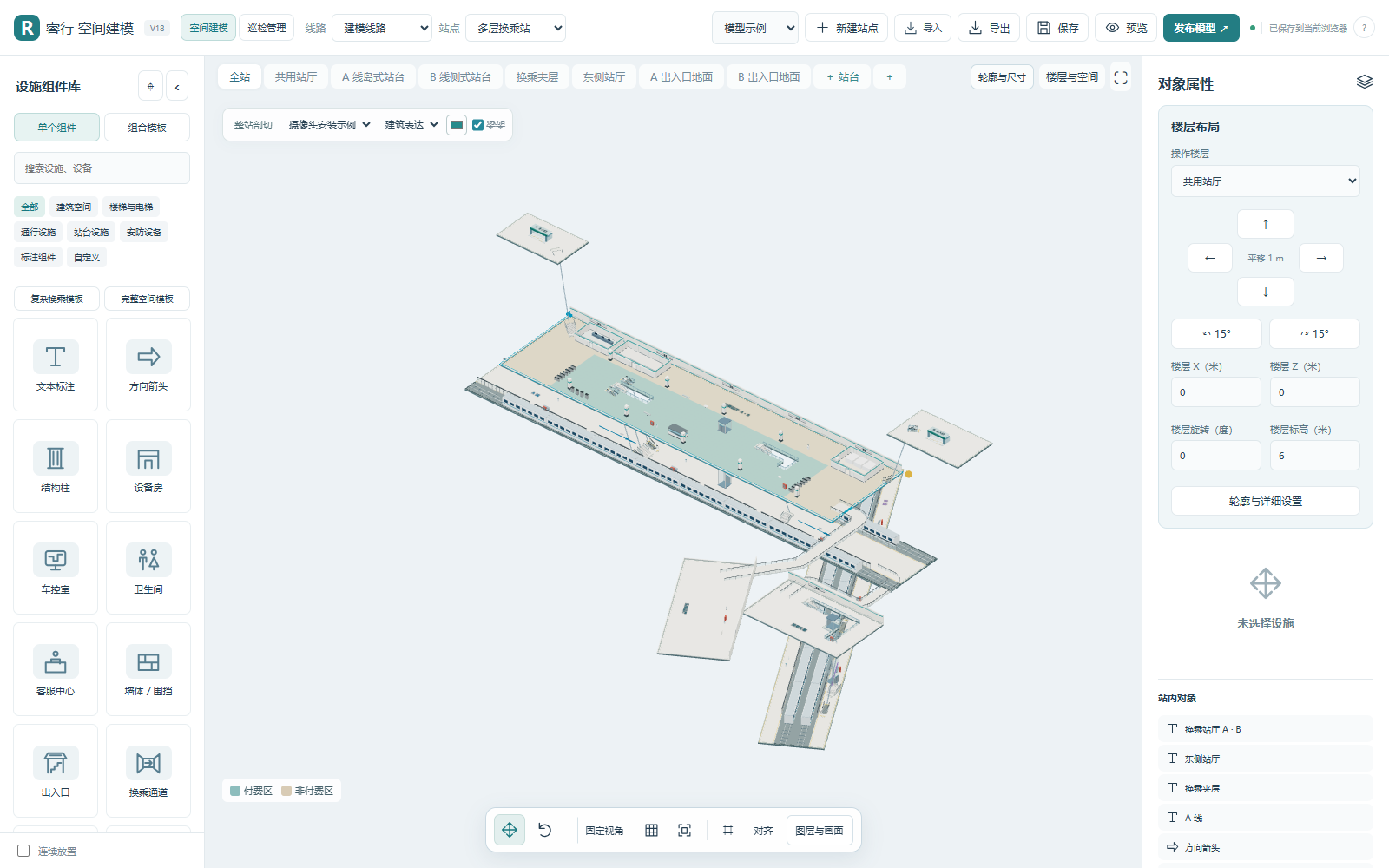
Actual demo interface in Chinese. Data and states are illustrative, not live operations.
THE THINKING / 02
From the problem to a working approach.
How can one station model support both patrols and incident response?
01 / Organise space
Begin with usable spatial relationships.
Model floors, rooms, equipment, entrances and connections. Edit, save and export objects that provide context for subsequent workflows.
Read the design choice
Design choice: spatial objects need identities that workflows can reference.
02 / Locate patrols
People and equipment share the same scene.
Navigate from the network to a line and station. Inspect personnel positions, tracks and status in their spatial context.
Read the design choice
Design choice: combine location and status to support coordination.
03 / Coordinate response
Carry spatial context into the incident.
Explore reporting, localisation, support, acknowledgement, arrival and field feedback using the same spatial relationships.
Read the design choice
Design choice: spatial information follows the work, beyond visualisation.
SPATIAL RELATIONSHIPSILLUSTRATION
Design choice: spatial objects need identities that workflows can reference.
Design choice: combine location and status to support coordination.
Design choice: spatial information follows the work, beyond visualisation.
APPROACH & DEMONSTRATION SCOPE
The operational question
Rooms, floors, entrances, stairs, equipment and platforms provide the physical context for patrols and response. A useful spatial model needs to connect these objects to the work taking place around them.
This English overview accompanies the Chinese case study. V18 combines station modelling, patrol views, communication and incident exercises using shared spatial relationships. The models are product demonstration samples, not surveyed station plans.
Explore the demo
The interface is in Chinese. Start with 空间建模 (spatial modelling), select a floor and inspect an object. Model editing supports undo, import, export and saved views. 巡检管理 (patrol management) connects the network, lines and stations to personnel locations, tracks and status.
Incident exercises cover reporting, localisation, assessment, support, acknowledgement, arrival and feedback. Camera footage is prerecorded demonstration material, not live surveillance.
Saving and session behaviour
Draft models and published snapshots are saved in the current visitor’s browser. Clearing site data removes those changes; export important models to a file. Patrols, dispatch and incident reports are temporary exercises that restart on refresh.
This public version does not provide cross-device collaboration or shared operational storage. It demonstrates the product workflow; deployment into an operational environment would require appropriate identity, permissions, storage and audit controls.